
The Pebble
Official Occasional Newsletter
of
The Marshall McLuhan Initiative, Inc.
Vol. II, Number 1, January 2026
What’s New with The Marshall McLuhan Initiative Inc.?
Past recipients of this newsletter may notice that we have a new logo. Why the change, one might ask? At a special meeting on branding, our Board decided that there was too much confusion, even among people in the know, between our stalwart troupe, heretofore abbreviated MMI — and TMI, The McLuhan Institute (https://themcluhaninstitute.com/), Andrew McLuhan’s beloved creation. Evidently, if there’s befuddlement, the “I’s” have it!
So, we have decided to emphasize the word “Initiative” in our name. The new design, created by our webmaster, Pamela Giles of Faithful Servant Consulting in Saskatoon, (https://faithfulservant.ca/), certainly complements the outward-spreading motion implied by our “pebble-in-the-pond” design. In a like manner, we thought that our old abbreviation, MMI, was too similar to beginning of the acronym, MMIWG2+, “Missing and Murdered Indigenous Women, Girls, and Two-spirited People.” For these reasons we have officially changed our abbreviation from “MMI” to “The Initiative.”
Having had a lot experience dealing with volunteer organizations, Giles suggested that Howard R. (J.) Engel’s title “President & C.E.O.” sounded more suitable for a business than a non-profit group. She suggested that “Executive Director” would much better apply to a registered charity like ours. Engel now proudly sports his new title, “Executive Director” of The Marshall McLuhan Initiative Inc.
This issue of The Pebble features reports on the numerous events since our last issue, i.e.:
- The Unveiling of the Blue Plaque at 507 Gertrude Avenue, September 20/25
- The event at Kelvin High School, “Remembering & Extending Marshall McLuhan: Kelvin Class of 1928”, October 16/25, which included:
•The launching of “The Media and the Write Competition” for Grade 12 and Undergrad students, with a deadline of May 31/26
•The presentation of The Medium and the Light Award for 2025 - Progress on the design plans to transform 507 Gertrude Avenue into the Marshall McLuhan Centre, where The Initiative invites guests to “Come for the Message” and “Stay for the Medium.”
~The Editors
Blue Plaque Unveiled to Mark 507 Gertrude as Home of “Memorable Manitoban,” Marshall McLuhan
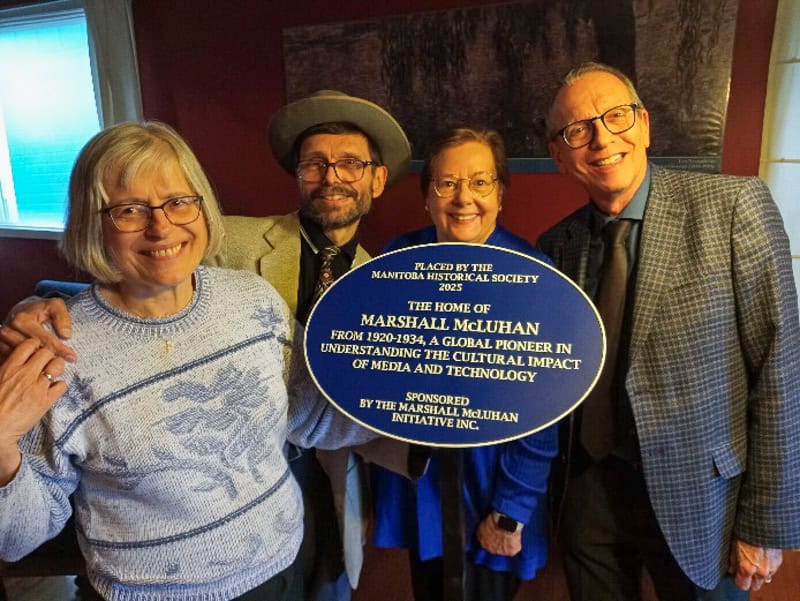
September 20, 2025 began with an early morning flourish: Nadia Kidwai, noted local CBC radio personality and host of The Weekend Morning Show, interviewed Howard R. (J.) Engel and Esther Juce about the unveiling of the “Blue Plaque” at 507 Gertrude Avenue to be taking place at 2:00 p.m. that afternoon. They explained that the Blue Plaque Program originated in London, England in 1866 to mark the homes of famous people. The present Unveiling was collaboration a between the Manitoba Historical Society (MHS) and our very own Marshall McLuhan Initiative Inc. The Plaque now marks the Gertrude house as the McLuhan’s primary childhood home, the address at which he lived from 1920 to 1934, the longest period in which he lived in any location.
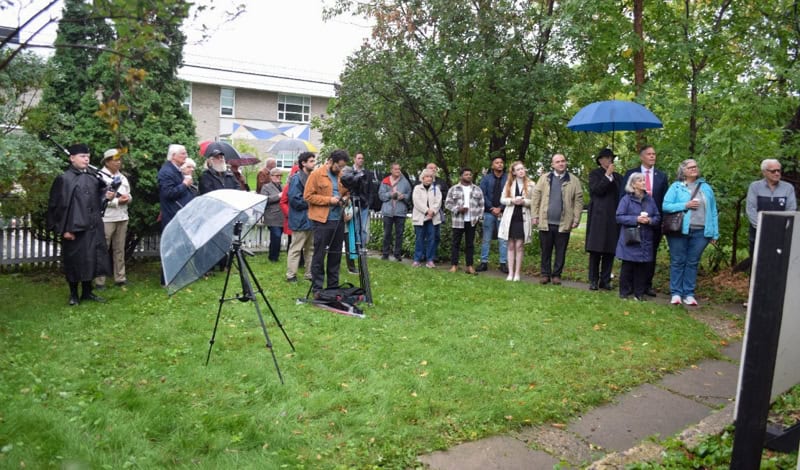
In spite of significant precipitation earlier in the day, the rain stopped (just for us!) for the entire duration of our program. Providence once more, as we would say! Some 30 attended in person, with least another 10 Zooming in, thanks to our Social Media Convenor, Isaac Klisch. (Unless otherwise noted, all photos of this event were taken by Milan Lukes, photographer for the Manitoba Historical Society.)
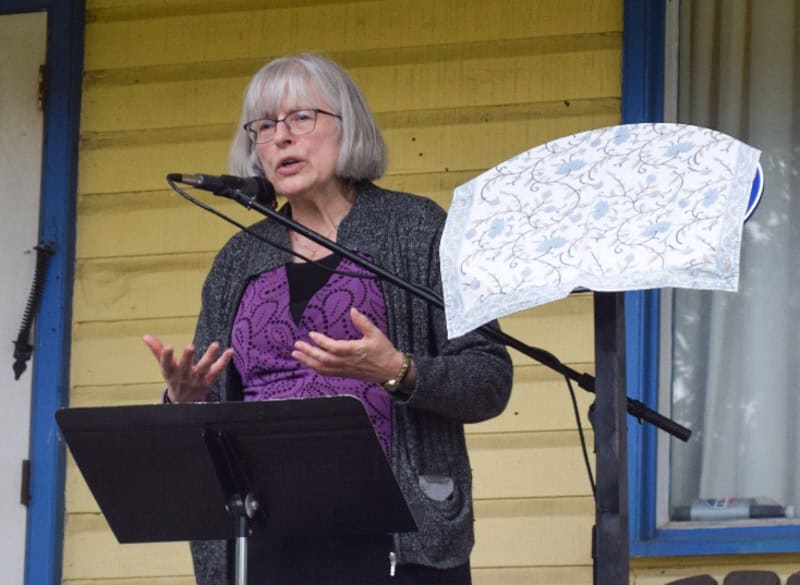
The program was rich in energy. It began with an impromptu interactive session led by Esther (photo) to warm up the audience. Topics covered during the exchange included the history of the Initiative and the late Richard Osicki’s role therein (see The Pebble, Vol I, No.2); the acquisition of 507 Gertrude (see The Pebble, Vol I, No. 1); the deleterious effects of social media and AI and what McLuhan would have thought of them; the meaning of “The medium is the message”; “hot” and “cool” media; and the antidotes to the negative aspects of the digital age, which include critical thinking, the respecting of history, the sanctity of community, and thorough involvement of our youth.
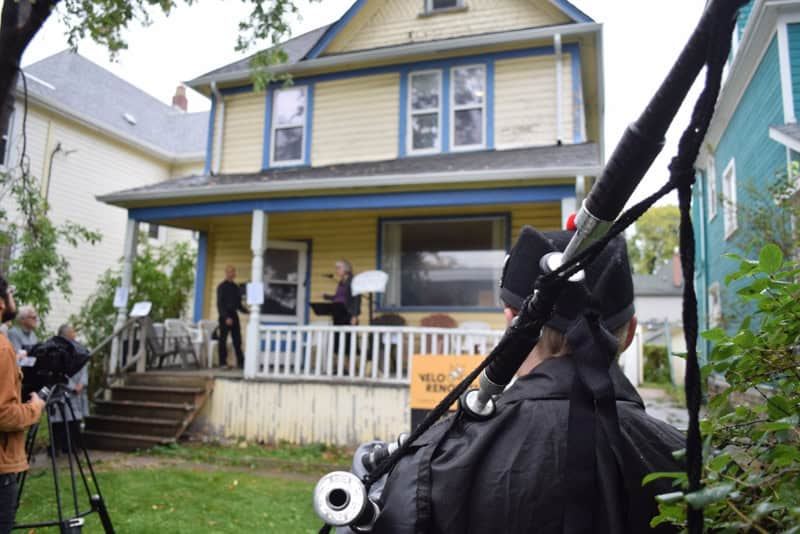
On cue, a young bagpiper, Matthew Owen-Hunt (photo) piped in the platform party, who took their places on the front porch of 507 Gertrude. The choice of this music was not accidental, since Marshall was very proud of his Scottish heritage and loved the bagpipe.
The program proper began with a welcome from The Initiative’s Executor Director, Howard R. (J.) Engel. He tantalized the audience with McLuhan’s classic comment about the microphone: “When you turn this thing on, you change everything.” Engel then declared the event to be the official beginning of the transformation of this modest building at 507 Gertrude into the Marshall McLuhan Centre.
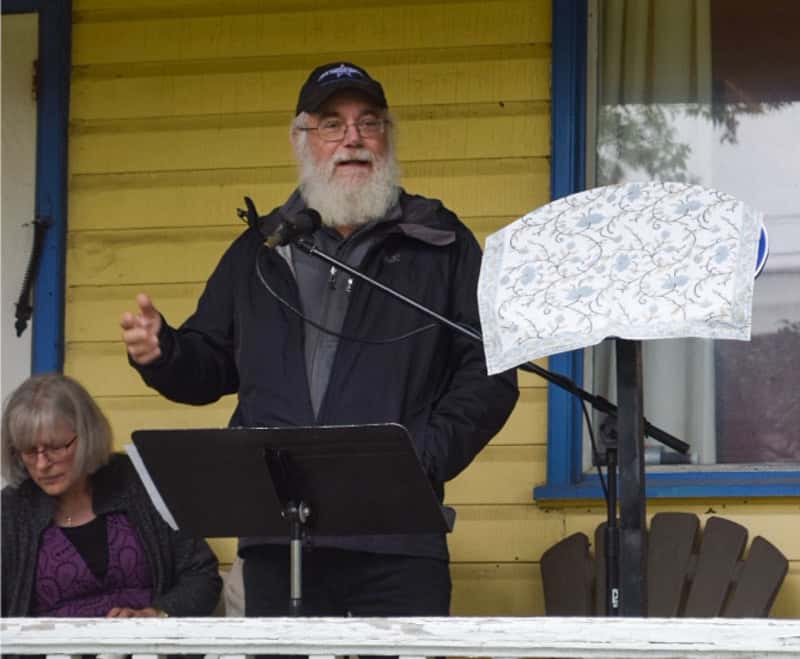
Representing the MHS, Dr. Gordon Goldsborough (photo) delivered the Land Acknowledgement, and shared that it was the Society’s delight to be assisting in marking the house at 507 as the former residence “of a truly great Canadian whose ideas continue to influence our modern world.”
Ben Carr, Local Winnipeg South-Centre MP, on behalf of the Government of Canada, handily expanded on McLuhan’s famous aphorism, “the medium is the message.” Carr declared that the future Centre would be a medium for “dialogue, research, creative exchange,” inviting us “to listen, to think critically, and to connect meaningfully” with the message. He concluded that these principles all play an crucial role in a healthy democracy.
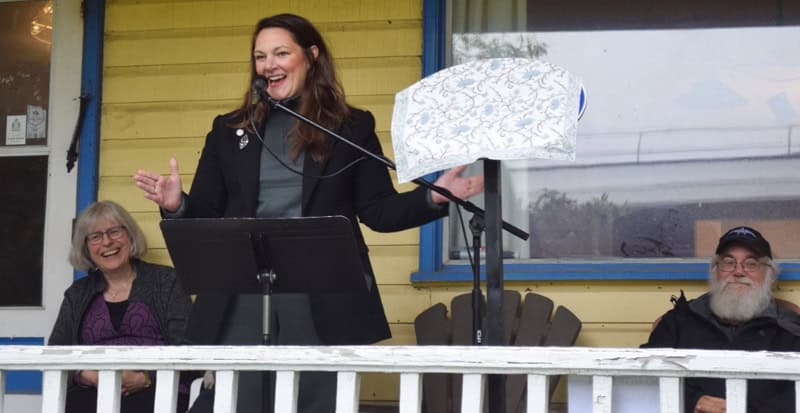
Ms. Sherri Rollins (photo), local Councillor for Ft. Rouge/East Ft. Garry, representing the City of Winnipeg, enthusiastically participated in the interactive exchange. Then during the program proper, she expressed support for youth in their education. She urged them to guard against the ills of social media and artificial intelligence through mindfulness and critical thinking skills. These words would definitely find approval from Marshall McLuhan himself!
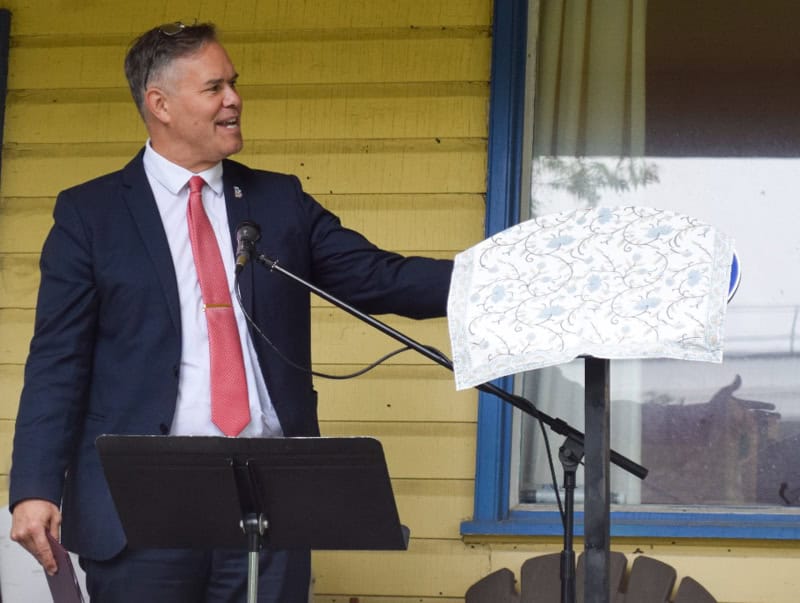
Mr. Robert Loiselle (photo), MLA for St. Boniface, representing The Hon. Wab Kinew, Premier of Manitoba and MLA for Ft. Rouge, on behalf of the Government of Manitoba congratulated The Initiative in its role in educating the public about such an influential thinker.
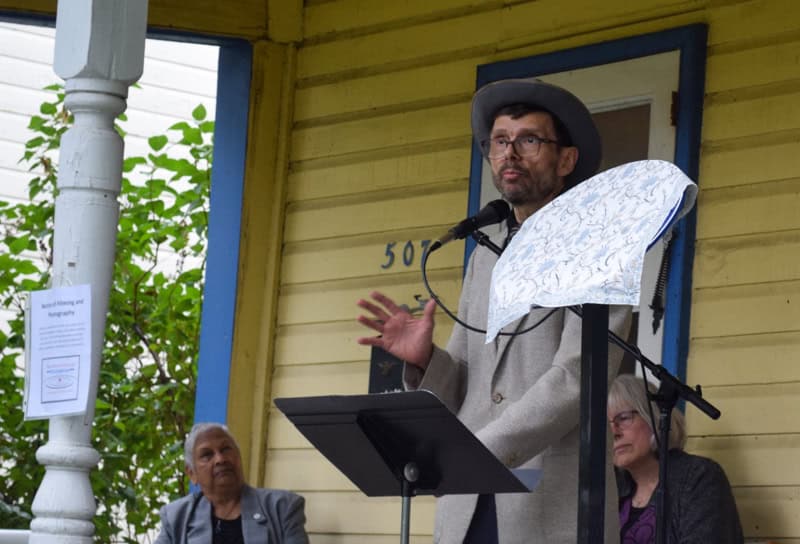
Engel (photo) then took the opportunity to explain McLuhan’s provocative comment about the microphone. Marshall maintained that every technology, such as the microphone, creates its own environment. McLuhan would analyse that environment utilizing one of his tools, the “tetrad” or four-pronged probe. His tetrad could explain the four effects of that technology. In this case, the microphone extends the reach of the human voice; obsolesces the megaphone; retrieves the town crier; and flips into its opposite, the cacaphony of many voices simultaneously vying for attention.
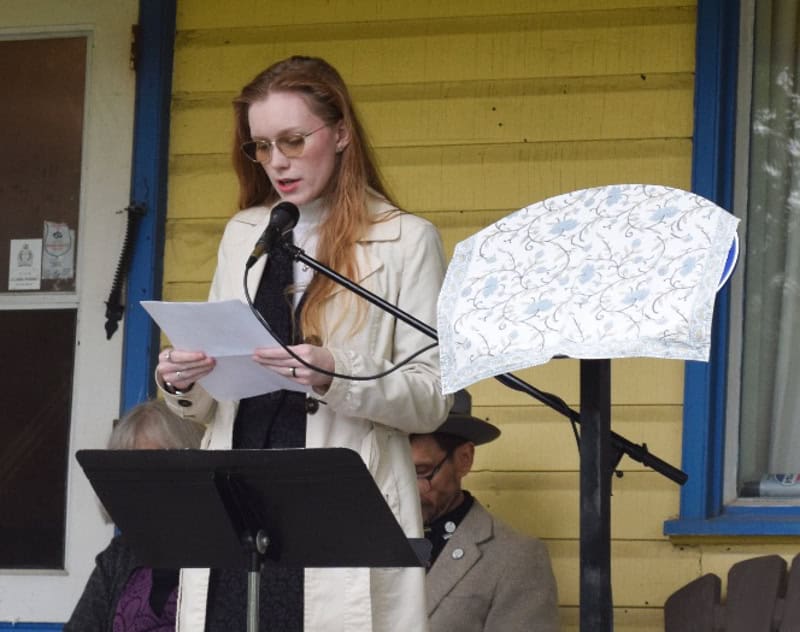
Dr. Heidi Marx, Dean of Arts at The University of Manitoba had been designated to represent the President of the U of M, Dr. Michael Benarroch. She was not able to attend, but sent a very energy-filled address that was read very capably in her absence by Board member Octavia Klisch (photo). Marx’ message referred to McLuhan as the “father of ‘media studies,’” and cautioned that his sometimes socio-politically controversial commentaries could often divide opinions. However, his methods and seminal ideas will always be beneficial for study, because “his thought [is a] conception of the technological as a structuring form of power.” Dr. Marx concluded that “McLuhan’s ideas remain salient,” since all of our modern challenges “have a technological dimension.” All in all, Marx declared that “the University of Manitoba is very proud to claim Marshall McLuhan as one of [its] most distinguished alumni.”
The principals of McLuhan’s three childhood almae maters gave their regrets due to the busyness of the beginning of the school year.
The crowd was then graced with a heartfelt recorded message from Michael McLuhan, Executor of the Corrinne and Marshall McLuhan Estate and their youngest child. The following link provides access to this address, plus the video and article of the Blue Plaque event at The Initiative’s Website: https://mmi-winnipeg.ca/unveiling-of-the-blue-plaque/.
Michael emphasized that the city of Winnipeg was central to his father’s formation. The house at 507 Gertrude Avenue was within walking distance of all four of the educational institutions that sparked McLuhan’s intellectual growth, from elementary school to university. Also, the close proximity of Marshall’s childhood home to the confluence of the Red and Assiniboine Rivers no doubt helps to explain his early love of boating. Lifelong friend and fellow Winnipegger, Tom Easterbrook, joined McLuhan with a fascination in communication and the study of media. While he began his university career in the faculty of engineering, McLuhan fell in love with English literature and switched majors, thus commencing, with a gold medal, his distinguished career in the field. Michael and the family heartily thank and bless The Initiative in its efforts to honour and extend the legacy of his father, Marshall.
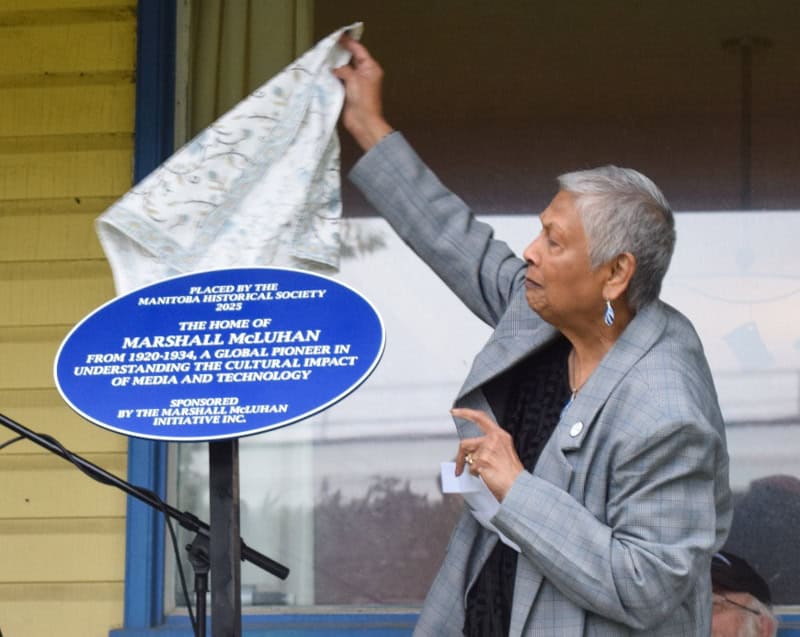
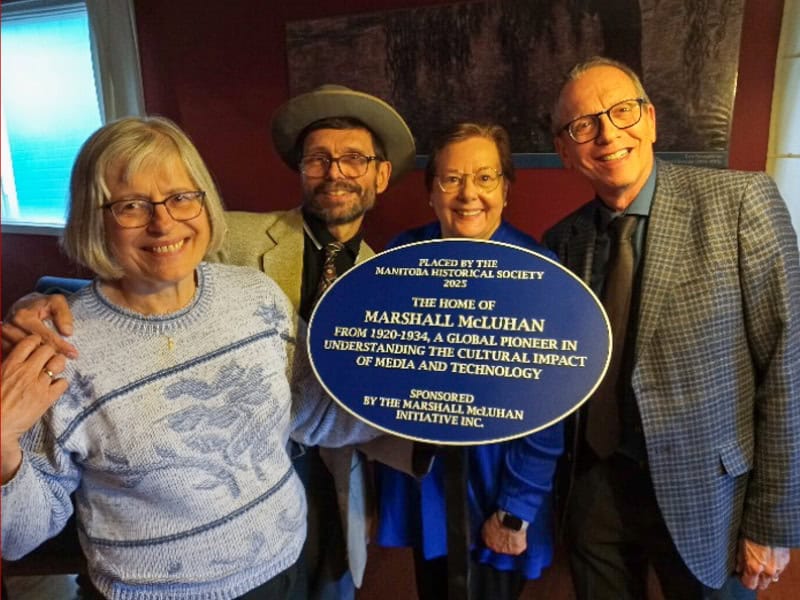
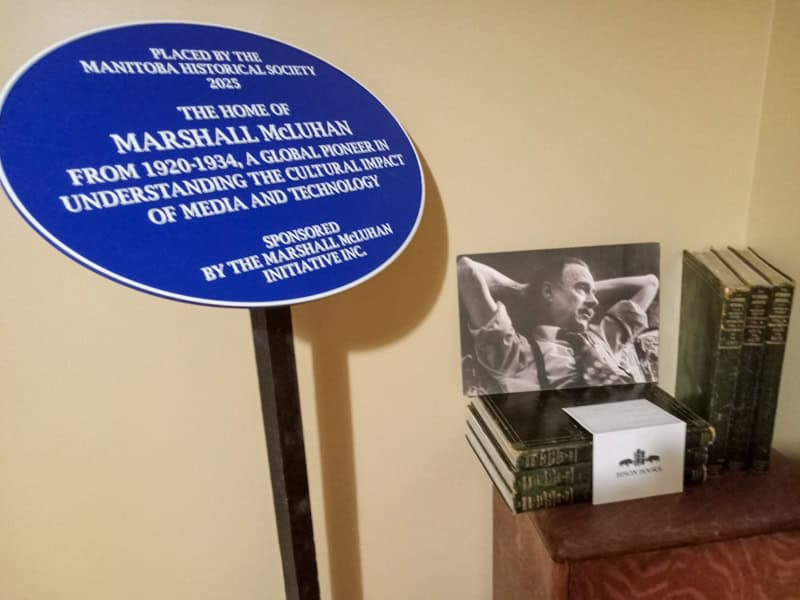
Finally, Board Member Diane Dwarka most graciously performed the physical unveiling and the reading of the plaque text: Placed by the MANITOBA HISTORICAL SOCIETY, 2025; The home of MARSHALL McLUHAN from 1920-1934, a global pioneer in understanding the cultural impact of media and technology; Sponsored by THE MARSHALL McLUHAN INITIATIVE INC. Diane concluded the unveiling by remarking that “this heritage house is more than just bricks and mortar,…History lives among us – not only in books and museums, but in the very walls we walk past each day.
After the program, attendees were invited to take pictures with the plaque, and to come inside the house for tours and light refreshments.
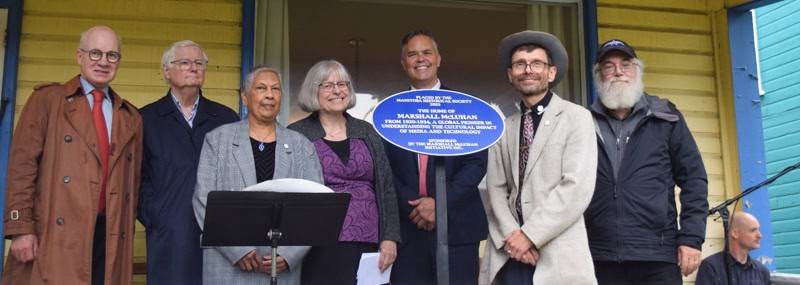
The event was captured in videography by Daniel Buckland of Point Row Records and in print by Nicole Buffie of the Winnipeg Free Press: McLuhan’s childhood home to become hub for big ideas.
The Unveiling of the Blue Plaque was a great success, not only in attracting supporters, but also in networking with government officials and esteemed members of the community.
~Esther G. Juce
Kelvin High School Celebrates One of its Most Distinguished Alumni:
“Remembering and Extending Marshall McLuhan, Kelvin Class of 1928”
September 2025 marked the 100th anniversary of Marshall McLuhan’s entrance into Kelvin Technical High School. To commemorate this notable rite of passage, The Marshall McLuhan Initiative Inc. cohosted with the School an information evening about McLuhan entitled “Remembering and Extending Marshall McLuhan, Kelvin Class of 1928” on October 16th, 2025. (Unless otherwise noted, all photos were taken by professional photographer Dan Gwozdz. This is the link to the professional audio and video files of this event taken by Daniel Buckland of Point Row Records: LINK)
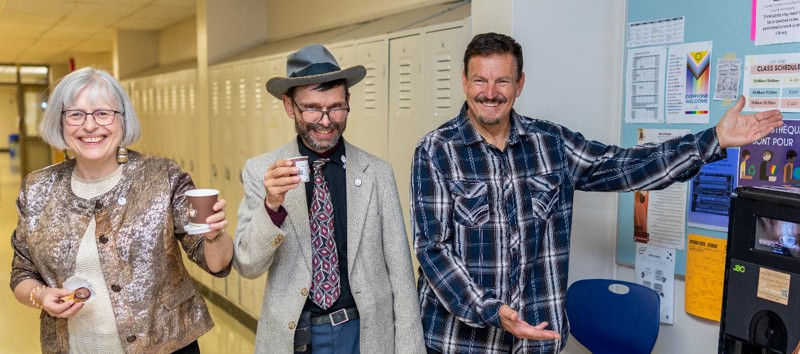
A few days before the event, The Initiative’s Executive Director, Howard R. (J.) Engel, exercised his library marketing skills by curating The Initiative’s collection of McLuhan-related books and memorabilia. (Display in Kelvin’s Library [photo] and in the adjacent hallway [photo]. The exhibit was in place from October 14 to 24, and served both to help publicize the McLuhan information evening, and to document McLuhan’s formative presence in Winnipeg. It was entitled “Marshall McLuhan, the ‘Memorable Manitoban.’”
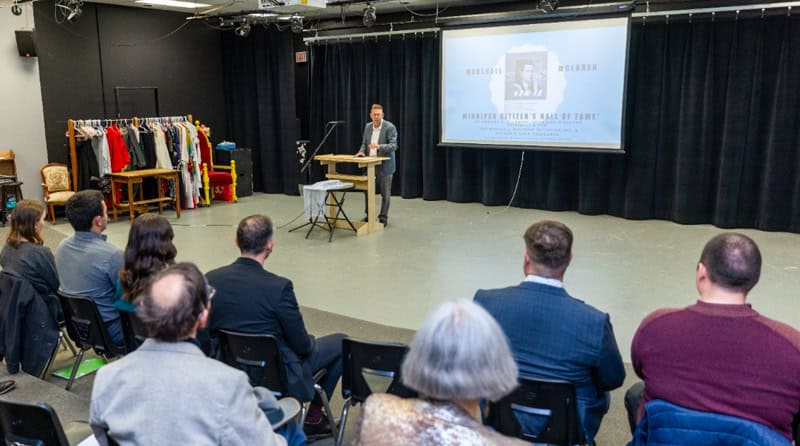
Two dozen people gathered at Kelvin’s intimate Lecture Theatre, while yet another dozen took in the event virtually, thanks again to Social Media Convenor, Isaac Klisch, the facilitator of this video-streaming presence.
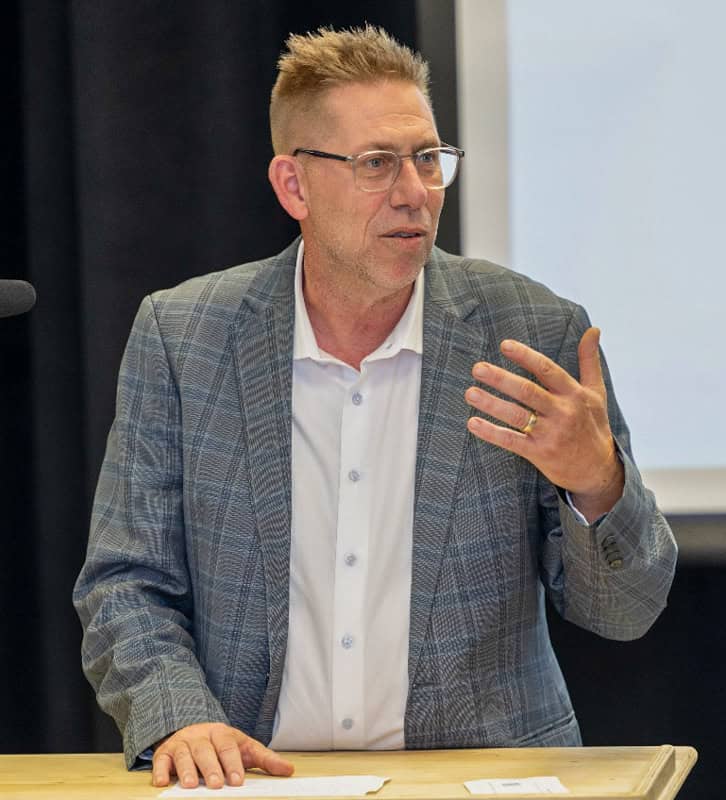
Timothy Cox (photo), the Principal of Kelvin High, had been an enthusiastic supporter of the event from the beginning, and his welcoming of the crowd that evening was no exception. Cox gave a warm greeting to all attending, highlighting not only the importance of the Kelvin School, but also that of our fair city and province, and that they had a kind of symbiotic relationship with McLuhan. While the environment of Marshall’s formative years left its impression on him, his notoriety as a world-class intellectual has served to “put Winnipeg on the map.” The principal closed by saying that he hoped that there will be more events like this one to continue The Initiative’s community outreach to educate Winnipeggers about one of their favourite sons, Marshall McLuhan.

Mike Moroz (photo), MLA for River Heights, the provincial riding in which Kelvin is located, then took the podium. Moroz’ articulate message demonstrated the importance of McLuhan’s thought. Moroz began by stating that McLuhan was decades ahead of his time and understood how media shapes us and changes the way we think, communicate, and connect. The MLA then continued that, as Minister of Innovation and New Technology, he is constantly considering how we can use technology to make life better for everyone. Moroz then reminded the audience that according to McLuhan, innovation is not simply what is new, but what is meaningful. It requires asking the right questions, namely, are we using technology to create or to destroy? He pledged that the government that he represents is working with the positive aspects of technology, “rooted in creativity, collaboration and community.” Moroz then completed his remarks with one of McLuhan’s aphorisms: “There are no passengers on spaceship Earth; we are all crew,” reminding the listeners that all have a role in shaping technology with the tools of responsibility and critical thinking.
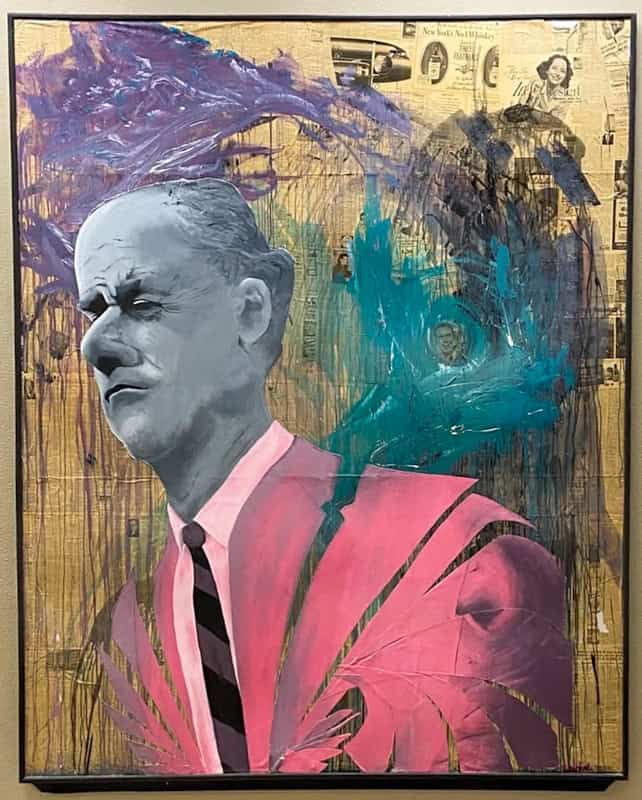
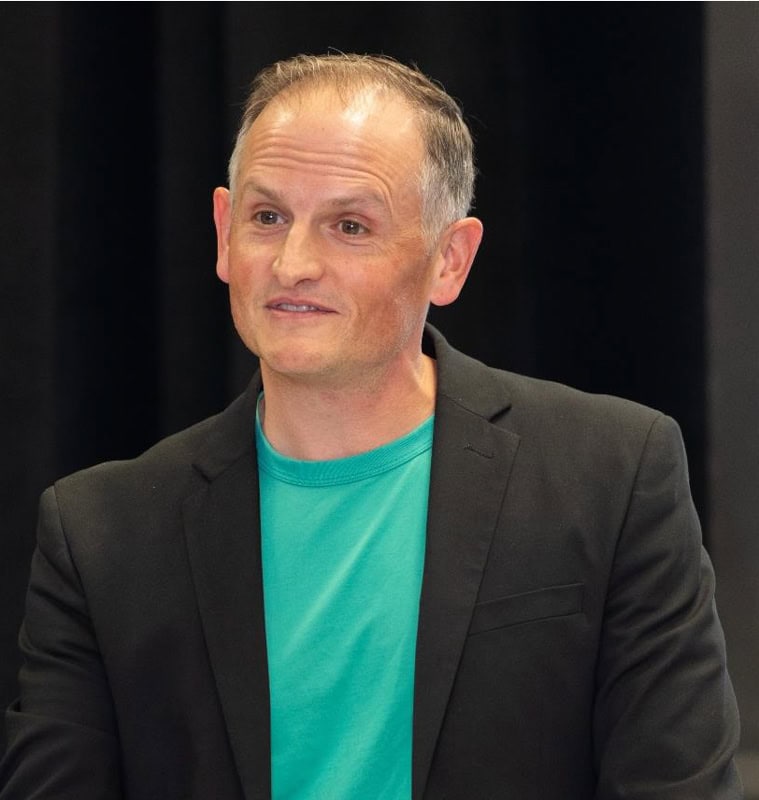
The next speaker on the program was History teacher Christopher Young (photo). It was Young’s fascinating presentation at The Initiative’s 2024 Symposium that inspired us to hold an information evening at McLuhan’s alma mater, Kelvin High School, in the first place. The history teacher certainly did not disappoint. Young led a lightning round quiz for the audience to name famous Kelvin alumni. Among the notable coterie were the usual suspects: rocker Neil Young, broadcaster Danny Finkleman, and of course, Marshall, or “Skinny McLuhan”, as his high school hockey chums called him.
The teacher continued with an allusion to a paper written in 1967 by McLuhan and George B. Leonard entitled “The Future of Education: The Class of 1989” (Look, February 21, 23-24. Online Source) This paper posits that education could and should be inspired by the entire world and its myriad environments and that one should not earn a living, but “learn” a living. McLuhan and colleague Leonard maintained that in the future, computers could be vaults containing “facts,” while the human brain would be free to engage creatively and critically. The History teacher then asked the question, “What would McLuhan find in the classroom today?” To complete his message, Mr. Young introduced three of his students who are keenly interested in McLuhan’s thought, a wonderful tribute to the continuation by young people of McLuhan’s legacy.
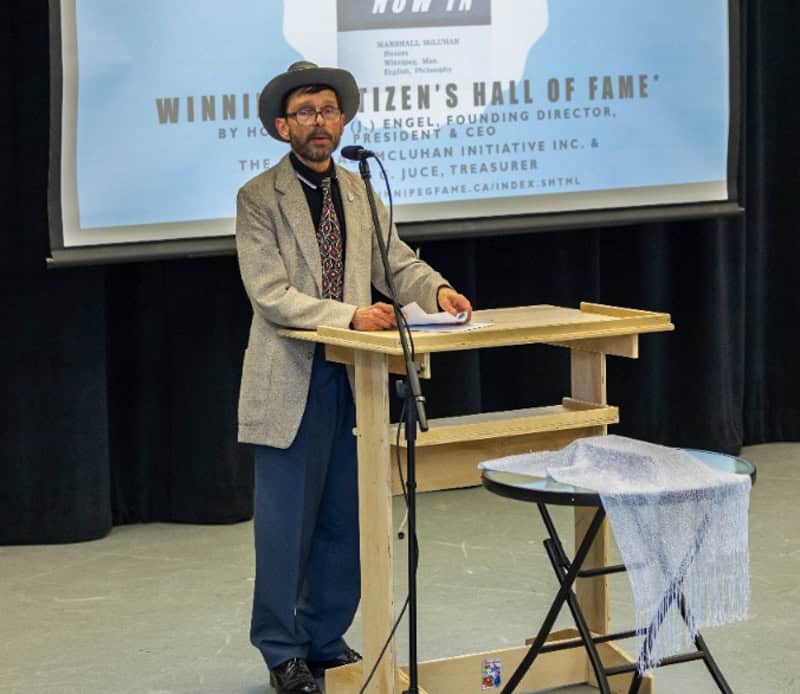
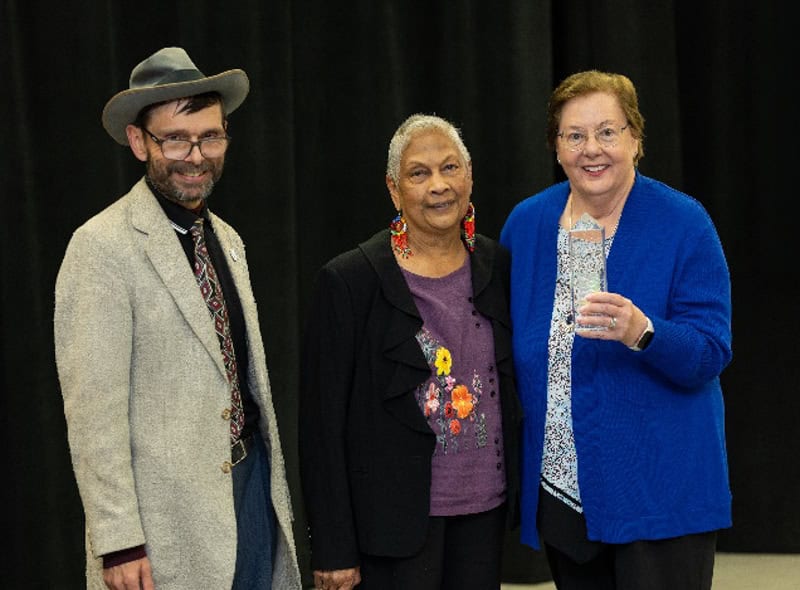
As a highlight of the evening, MC Howard R. (J.) Engel, Executive Director of The Initiative, (right) introduced the 2025 recipient of The Medium and the Light Award, Dr. Geri Forsberg of Western Washington University. Forsberg then gave an inspired address on the faith of McLuhan, which was very well received. It was commented that of all the winners of the Award, her address most closely captured the ethos and raison d’être of The Initiative. (For a detailed account of the unveiling and presentation of the Award, please see the article “The Medium and the Light Award for 2025.” See also the “Synopsis of Dr. Geri Forsberg’s Keynote Message.”)

The final item on the program was cleverly articulated by the Board member, Dr. Jonathan Slater of Montreal (photo). According to him, “Marshall McLuhan is the most quoted Canadian of all time.” Slater outlined the parameters of The Initiative’s inaugural competition for Grade XII and undergrad university students in Manitoba called The Media and the Write Competition, (obviously a riff off of The Medium and the Light Award!)
The Initiative’s “Wiseman from the East” explained that students would have an opportunity to quote the media visionary, Marshall McLuhan, themselves in a short paper or project, including media ecology, fiction, poetry, art, music, or videography/photography. The prizes will be awarded in two tiers, will include cash prizes ranging from $500 to $1,000, and will include a book by or about McLuhan, as well as tickets to The Initiative’s Inaugural Winnipigeon Gala Banquet on October 8th, 2026. It will be at this Gala that the winners will be invited to share a short portion of their work. The deadline for submissions is May 31, 2026. (This is the link for more information: https://www.mmi-winnipeg.ca/the-media-the-write-competition/ )
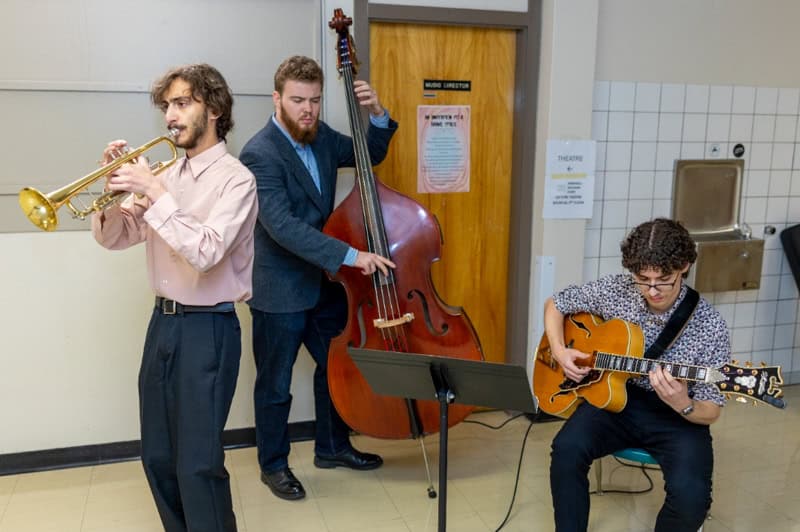
To round out the evening, a jazz trio (photo) from McLuhan’s alma mater, the University of Manitoba, played background music before the formal part of the program and during the reception that followed. Featured were De Luca’s delicious desserts and Barry Morwick’s Java Infusion coffee.
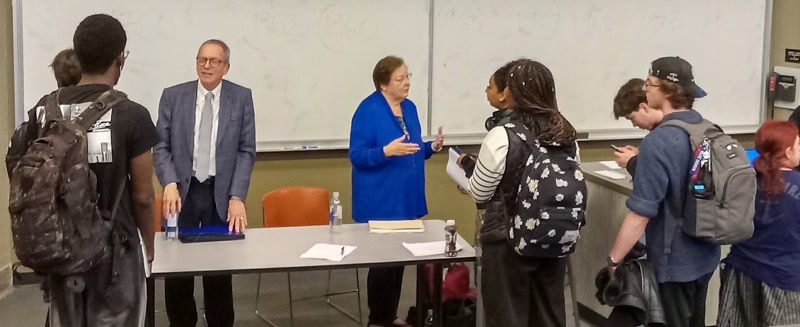
A lovely collateral benefit of Geri’s and Jonathan’s presence in Winnipeg was their presentations to the circa 120 students of Dr. Connie Macrae-Buchanan’s Introduction to Political Science class at the University of Manitoba during the afternoon of October 16 before the event at Kelvin. The opportunity to capitalize on the presence of these two media ecologists in our city was too enticing to forgo.
Dr. Forsberg’s words to the students were a contemplative yet courageous tribute to McLuhan’s faith. In her presentation, she stated that it was not unreasonable to discuss McLuhan’s faith in that classroom, since the University of Manitoba was founded in 1877 as a faith-based institution. Dr. Slater’s presentation was a rousing account of the timeline of politics in Quebec, illustrating the necessity of knowing historical contexts when probing the meaning of our environments.
~Esther G Juce
The Medium and the Light Award for 2025

The fourteenth Medium and the Light Award, in recognition of the ecumenical dimensions of the life and work of Marshall McLuhan, was presented to Dr. Geraldine E. Forsberg (photo) of Western Washington University on Thursday, October 16, 2025 as a feature item in the program of “Remembering and Extending Marshall McLuhan: Kelvin Class of 1928,” an information evening held at école Kelvin High School in Winnipeg, Manitoba. She was the first recipient ever to be asked to deliver a keynote address, and she did so beautifully, speaking on “The Faith of Marshall McLuhan.”
In her preliminary remarks, Forsberg, pointed out another first:
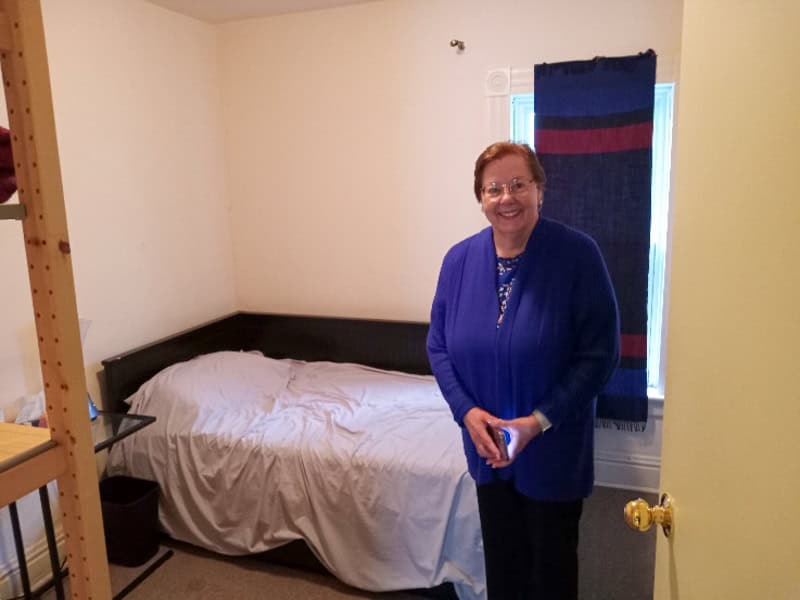
Last night, I had the privilege of being one of the first McLuhan scholars to stay overnight in the McLuhan house [at 507 Gertrude Avenue], the house Marshall grew up in as a boy [to young adulthood, from 1920 to 1934].
I want to publicly thank Esther Juce and Howard R. (J.) Engel, along with the Board of The Marshall McLuhan Initiative Inc., for purchasing the home. They collaborated with the Manitoba Historical Society … to facilitate … the designation of the site as a historical landmark [through the internationally recognized “Blue Plaque” program]. In the future, other McLuhan scholars will also be able to come here to write and study. This will be a fantastic opportunity for writers and scholars for decades to come.
Dr. Forsberg is a media ecologist and researcher of “how the faith perspectives of the founders of media ecology (particularly of Marshall McLuhan and Jacques Ellul) influenced their views on media and communication.” She graduated in 1991 from New York University. “Her essay, ‘Navigating the Maelstrom: The Significance of Marshall McLuhan’s Faith for 21st Century Media Scholarship,’ was presented at the McLuhan’s Faith and Works Conference in 2015 in Winnipeg” at St. Paul’s College, the University of Manitoba, co-sponsored by The Marshall McLuhan Initiative.
Geri’s recent work has focused on the nature of being human in a technological society, the impact of language changes on the world, and the role of faith in higher education. Her doctoral dissertation, Critical Thinking in an Image World (1993), was published by the University Press of America. In that book, she provided a theoretical foundation for teaching people how to think critically about visual images. Her essay on worldviews, “Neil Postman and the Judeo-Christian Worldview,” published in the Journal of Communication and Religion, has been used in many university communication courses across North America. At Western Washington University, Geri teaches courses in professional writing.
The Initiative’s Board of Directors unanimously nominated Dr. Forsberg as the recipient of this year’s Award for good reason. It has been said of Dr. Forsberg that the ecumenical sensibility [of the award] is manifested in her McLuhanesque probes on the world, and on the work of McLuhan’s contemporary, media ecologist Jacques Ellul.
Forsberg and her subjects were all informed by their Christian faith. Geri effectively draws our attention back to the source of much of her inspiration and hope for the world in the example of Marshall McLuhan’s faith-infused work. Forsberg is one of the few media ecologists who has explored — in the dialog between McLuhan and Ellul — the meaning of McLuhan’s seminal quote: “In Jesus Christ, there is no distance or separation between the medium and the message: it is the one case where we can say that the medium and the message are fully one and the same” (The Medium and the Light, 1999, p. 103).
Her quiet determination and commitment to collegiality as she examines the effects of technologies on human beings are reminiscent of McLuhan’s own desire to engage with like-minded and like-hearted explorers such as Ellul. She effectively uses print media and a disarming, honest and open face-to-face delivery to invite people into relationship with each other and to utilize Marshall’s probes. Forsberg maintains that his tools are in turn informed by his relationship with the Risen Christ, bringing a message of encounter and belonging that we need more now than ever in our over-mediated and increasingly fragmented world. As Geri said in her talk, “for Marshall McLuhan, the Word made flesh, God Incarnate, serves as the divine foundation for all media theory and communication.”
As McLuhan once said, “I don’t want them to believe me, I just want them to think.” Likewise, Forsberg practices what she preaches and teaches in designing and delivering courses that invite her students to become not only critical thinkers in their own right, but to be open and disposed to the spiritual dimensions of media ecology.
Furthermore, she inspires her students to harness their personal creativity by expressing themselves and communicating meaningfully through various media, just as Marshall did. Her academically rigorous explorations on what is happening culturally in our global village contribute immensely to McLuhan studies with a different way of knowing through the eyes of faith in Canada, the U.S. and beyond. So, McLuhan’s observations, or as he would call them “probes,” on the world around us permeate Forsberg’s work and cry out for recognition.
For these compelling reasons, The Initiative’s Board recognizes Geri Forsberg as a most worthy “spiritual inheritor of McLuhan’s thought.” Her foundational legacy and indefatigable trail-blazing uniquely marry the field of media ecology with a Judeo-Christian world view characterized by the Award itself. Let it be a token of our gratitude and encouragement for the masterful way she fosters awareness of media effects in our midst today and why it is important for others to hear McLuhan and other media ecologists like Jacques Ellul and Alfred Korzybski. As a leading member of this venerable coterie, she cautions against getting caught up in the vortex of technologies, but to rather choose to reshape our tools before they reshape us into their own images. This kind of resistance against technological and cultural determinism, a resistance championed by McLuhan, is a message we cannot ignore.
Forsberg’s seminal book, Critical Thinking in an Image World: Alfred Korzybski’s Theoretical Principles Extended to Critical Television Evaluation (1993), and many provocative articles, such as the aforementioned “Marshall McLuhan and Jacques Ellul in Dialogue” (Journal of Religion and Communication, 2020), inspire us to continue our explorations in true McLuhan fashion.
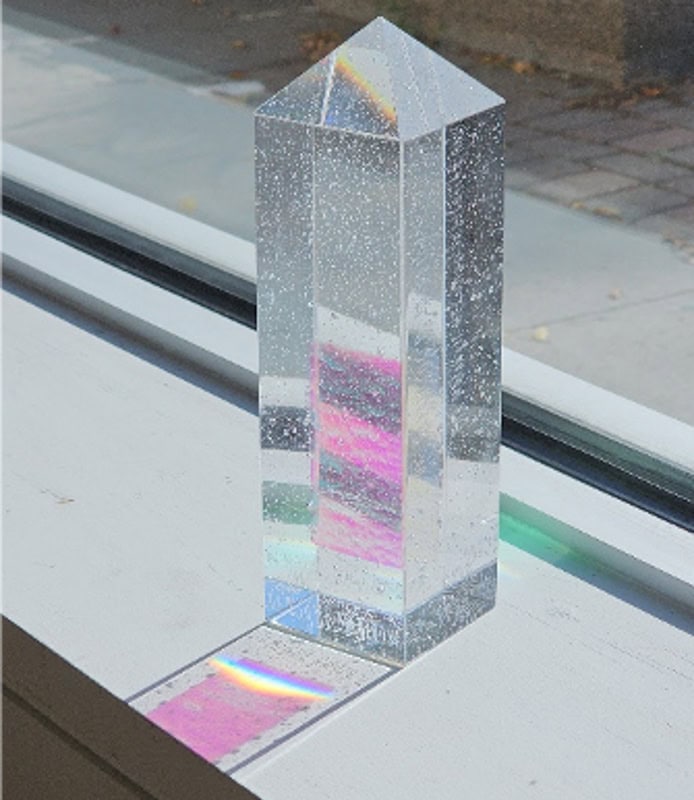
The Medium and the Light Award is usually given annually by The Marshall McLuhan Initiative Inc. It consists of:
- a crystal-clear soda glass obelisk (measuring ca. 2 x 2 x 8 inches and 3 pounds in weight)
- embedded in a piece of opalescent dichroic glass
- upon which the pebble-in-the-pond logo of the Marshall McLuhan Initiative has been etched.
- This dichroic glass has a very thin multi-metal coating that refracts light in many different colours.
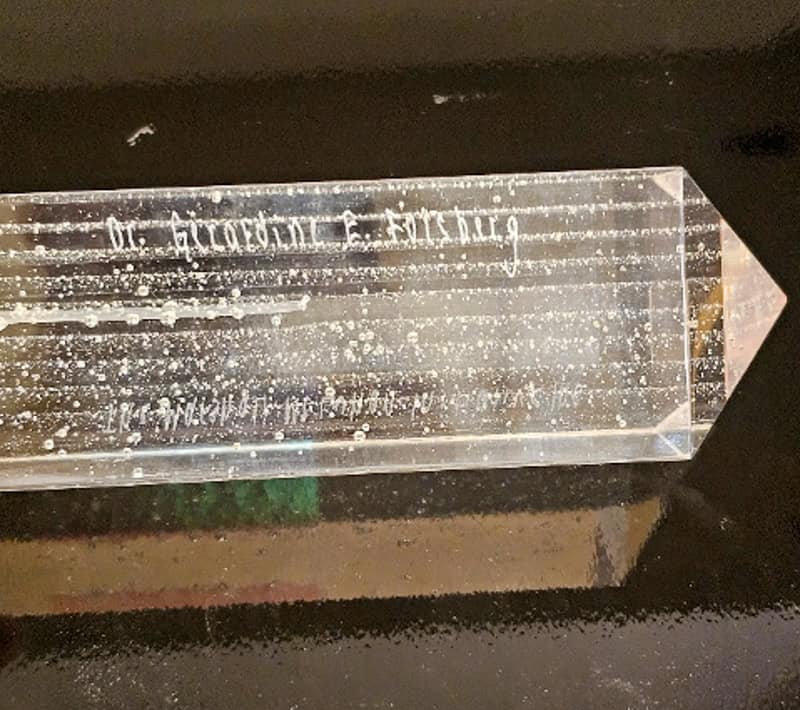
- Both the award and recipients’ names are etched horizontally on the obelisk’s surface.
Once again, this year and going forward, the award will be accompanied by a $1,000 cash prize from the Roland R. and Doris M. Engel Family Fund at the Winnipeg Foundation.
~Howard R. (J.) Engel
Synopsis of Dr. Geri Forsberg’s Keynote Message
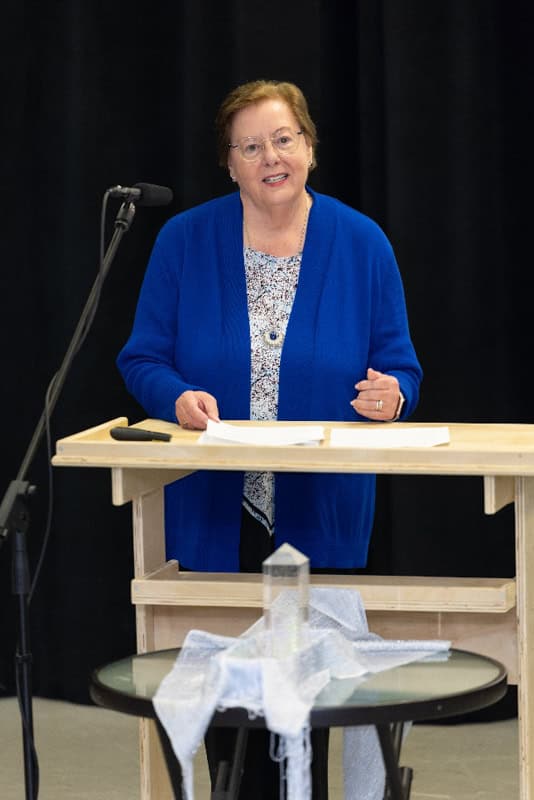
Dr. Forsberg (photo) gave an enlightening profile of the relationship of Marshall McLuhan and Jaques Ellul of France. Although they had never met in person, they read each other’s books and responded to each other’s key ideas. For example, in the Fisher Rare Books Library at the University of Toronto, Dr. Forsberg found four copies of Ellul’s The Presence of the Kingdom (1948). Marshall had not only read each copy, but had annotated each one with copious underlining and notes. Eric McLuhan, Marshall’s son and collaborator, quipped that Marshall loved the book so much that he sent it out to at least 12 friends.
Of course, before connecting with Ellul, McLuhan had had his own spirituality. As an undergraduate, Marshall read his Bible daily. He was looking for a spiritual ‘city’ which had strong foundations, and this he was to find in the Roman Catholic Church. While studying at Cambridge, McLuhan was inspired by his readings of Thomas Aquinas and G.K. Chesterton. Marshall once wrote, “Had I not encountered Chesterton, I would have remained agnostic for many years at least” (Molinaro, McLuhan, & Toye, Letters of Marshall McLuhan, 1987, p. 73).
McLuhan prayed, asking God for a sign. One day, in 1937, when he was 25 years old, he was kneeling and praying for the truth. He experienced a conversion that changed his life forever. It came instantly as immediate evidence, and without any question of its being a divine intervention. He simply had wanted to know what was true, and he was told – wham! (McLuhan & Szklarek, The Medium and the Light: Reflections on Religion,1999, p. xvii).
Then, when he read Ellul’s book, which emphasized the role of Jesus Christ in our world and His eternal Kingdom, his eyes were opened to the role of faith in the world, in education, and in communication studies. Dr. Forsberg claimed that McLuhan’s readings of Ellul influenced all of his media and communication theories. Ellul’s emphasis was on the Word, the Transcendent One, and His role in our world. The knowledge that the Word became flesh—God entering the world in human form—became McLuhan’s key to understanding all media. If God chose to communicate through the flesh—through the physical, the visible, the audible— then human communication is likewise a spiritual act.
McLuhan posited that Jesus Christ is the “divine medium,” the ultimate communicator. He realized that Jesus Christ is both the Medium and the Message. In his words, “In Jesus Christ, there is no distance or separation between the medium and the message: it is the one case where we can say that the Medium and the Message are fully one and the same.” Just as the media are not neutral vehicles, Christ is not merely a Messenger, but the Message itself embodied. This led McLuhan to see media not just as neutral tools but as incarnational events.
McLuhan knew that our technologies and media always give and take something from us. He believed that modern media technologies could desensitize us to truth, fragment our attention, and create false “global villages” that imitate community but lack its core values. McLuhan believed that only by returning to the Incarnational model—truth in flesh, word in action—can communication be redeemed.
For McLuhan, authentic communication must imitate Divine communication, which is loving and self-giving. Just as God communicates with us through an embodied human form, so should humans embody their communication in our presence of listening, dialoguing, and loving others. For McLuhan, disembodied, manipulative, or purely technological communication violates the incarnational model.
In conclusion, for Marshall McLuhan, the Word made flesh, God Incarnate, serves as the divine foundation for all media theory and communication. If McLuhan were here today, Geri posited that he would warn against disembodied communication, where we outsource our thinking, reasoning, writing, and artistic work to AI. He would encourage us to reclaim our humanity by developing integrity between thought and action. And he would stress the importance of faith in the Incarnate transcendent Word.
Dr. Forsberg completed her moving presentation in this way: “In [McLuhan’s] words, as a way of knowing, faith functions in the realm of percepts rather than concepts. Faith is a form of spiritual awareness and understanding, as sharp and tangible as sight, touch, smell, and hearing. He would say, and I quote, ‘If you want faith, you can simply get down on your knees and ask for the truth. It will change your life.’”
~Esther G. Juce
Evolution of the Plans to Transform 507 Gertrude Avenue into the Marshall McLuhan Centre

Because the original house at 507 Gertude Avenue (photo) had a lovely ambiance and aesthetic, we hoped to leave the building as is, and upgrade it only as necessary.
However, one of our hopes was to have a scholar-in-residence and perhaps a student-in-residence, and still use the living room and dining room as public spaces for our events. This was going to have made zoning complicated: could we have had a hybrid zoning (i.e., private and public) at the same time? If we were to have such a zoning, we may have needed a horizontal fire barrier between the two upper levels to separate the private area from the public. This would have been prohibitively expensive and disruptive.
We had other needs as well. Two of the three companies that bid for our project said that that we needed major foundation work to improve moisture control. We also wanted more storage area. Finally, we had the dream of converting the attic into an experiential space.
What were we to do?
A suggestion was made that could accommodate all of our needs. This new idea was that we demolish the newer part of the house, which had been added around 1980 (along with the detached garage), and to likewise raze the garage behind the house. We could then build an addition onto the north side of the house as far back to the back lane as possible. This would still leave room for three parking spots.
This new addition would address a lot of our concerns. It would maintain a private space on the second floor for the resident(s), a mixed space on the first floor in the original house, and an entirely public space in the addition in the main and second floors. In a nutshell, what was needed were two separate buildings that would be joined, with a firewall in between the old part of the building and the new addition. This construction would meet the fire regulations and make rezoning easier.
Since the foundation work had to be done and would be necessary for the rezoning, extending the basement was reasonable; the entire basement, addition included, could all be done at the same time. In this fashion, we could have a more climate-controlled space for the library in the new, all-but-self-contained part of the basement and would gain storage space in the old portion.
What about the dream of creating an experiential space? Converting the attic space would have required major, cost-prohibitive structural engineering extending down to new beams, floors and tele-posts / piles in the basement to accommodate the added load that a functional attic space would have required. Building a new addition would thus make the dream come true in a significantly more economic and less obtrusive manner. The experimental area could hold a lot more people (70-80) instead of only 15–20 in the living/dining room space in the old part of the house).
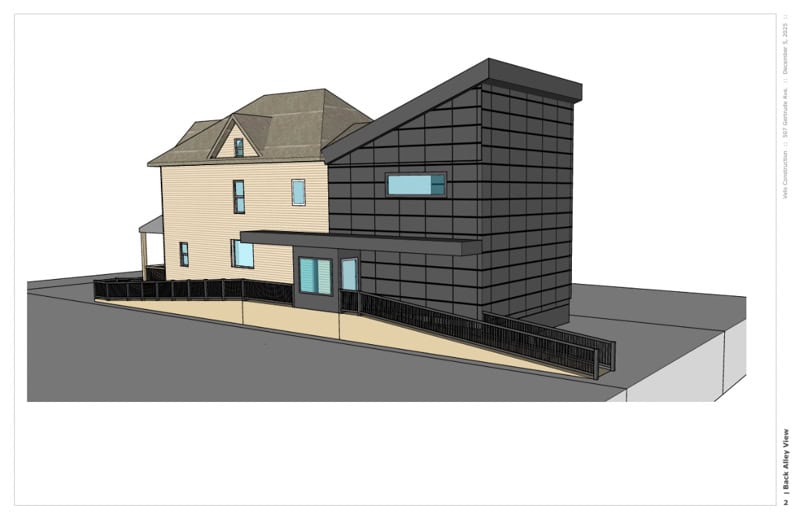
What about accessibility? This would be an important question not only for the general public, but also if our scholar- or student-in-residence had mobility issues. The second-floor washroom would be completely accessible. We would place the accessible public washroom on the first floor in the new addition with a simple door to the “experiential space” / gallery. There would be a ramp outside to the side door as well as an accessible parking spot. Finally, we would install a three-level lift in the new addition to give the resident(s) access to all the floors, and to give the public access to the planned mezzanine floor in the “experiential space” gallery. The lift would cost around $45,000, a necessary and prudent investment that would allow the participation of all.
In the end, keeping the building as originally outlined would have been almost as expensive as the proposal of building an addition. However, this latter approach would meet all of our needs.
We could also do more justice to McLuhan’s principle of meaning of a structure by preserving as much as possible the heritage character of the original living/dining room. This would be the convivial, “McLuhan’s Salon”, the all-important “third space”.
We would have the “experiential space” in the new addition, which could be populated by McLuhanesque features that entertain all the senses.
With this design, we would be able to accomplish all of our aspirations for The Marshall McLuhan Centre, including accommodations for a scholar- and possibly a student-in-residence; office space shared between them and The Initiative; an intimate gathering space accommodating 10-20 people in the living/dining room area in the original building which could be rented out to like-minded groups and individuals; more storage space; the façade and a museum room restored to the period 1920-1934; a safe environment for the library in the basement; space to display McLuhan materials and memorabilia; and last but not least, an experimental space accommodating 70-80 people where films and presentations could be enjoyed, and doubling as a gallery which could also be rented by artists.
This new construction would be both welcoming and fascinating, bringing to mind Howard’s riff off of McLuhan aphorism, “The medium is the message”:
“Come for the Message; stay for the Medium!”
~Esther G Juce